
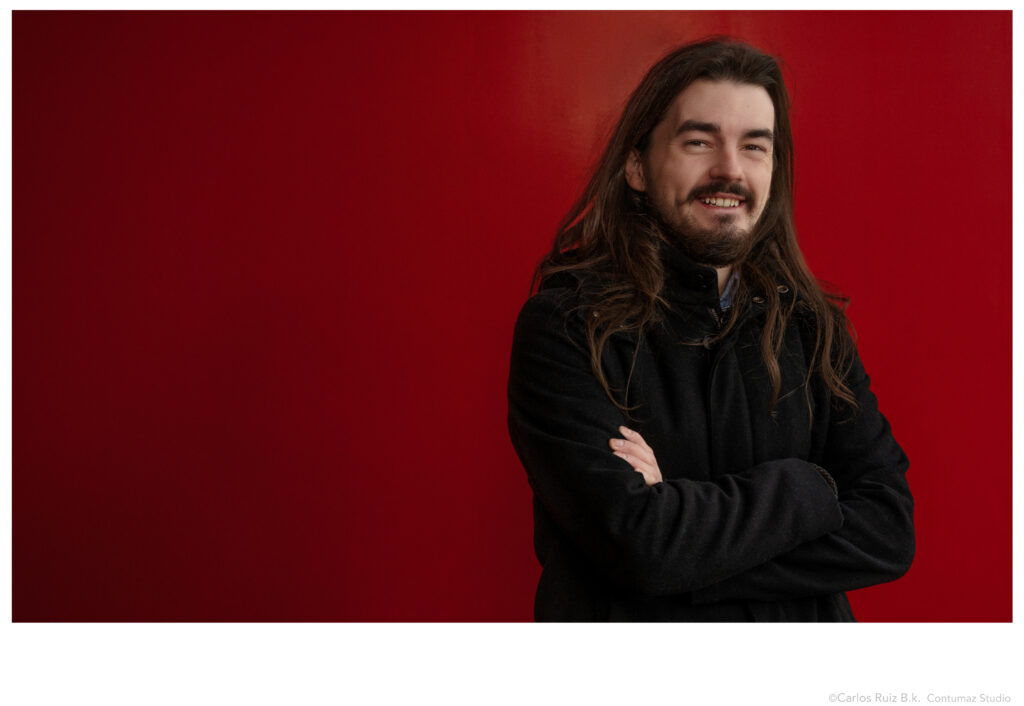
The vast universe of social media isn’t just filled with hoaxes, inflammatory content, and junk. It also features high-quality science outreach. Take Puto Mikel, for example. An archaeologist, writer, and YouTuber, Mikel Herrán (born in Zaragoza in 1991) has become a media sensation. His YouTube channel has 327,000 subscribers. On Instagram, he has 331,000 followers. And many of his videos are nearing one million views.
He holds a master’s degree in Archaeology of the Arab World from University College London and contributes to RNE, El Intermedio, and Carne Cruda. His biting and caustic Reels delve into history with wit and humor from a fresh and innovative perspective that has captivated thousands of young people. On Thursday, the 24th, he will deliver a lecture at the Faculty of Philosophy and Letters in Córdoba on “The Universal Legacy of Al-Andalus” as part of the Year of Averroes. The event has been organized and sponsored by the Las Fuentes Foundation.
QUESTION: And what is the universal legacy of Al-Andalus?
ANSWER. In general, every culture contributes to world history. In the case of Al-Andalus, there is a very clear legacy: an Islamic society was established in Europe that lasted more than seven centuries and influenced the exchange of goods, diet, and philosophical ideas. Al-Andalus is essential to understanding the transition from classical to Renaissance philosophy. For example, one cannot understand St. Thomas Aquinas without considering his engagement with Aristotelian texts—which had reached him in translation via the Arab world—and with Eastern thinkers with whom he engaged in dialogue, sometimes in a spirit of understanding and other times of confrontation.
That dialogue has advanced the history of European thought as we understand it today. Beyond ideas, the Al-Andalus legacy is present in food and art. And it did not disappear after 1492; rather, it forms part of our own culture in Spain and even in the Americas, where customs and traditions of Al-Andalus origin were brought over with the conquest and evolved once more upon arriving in that new context.
Q. And what is the “journey of facts and ideas,” as indicated in the subtitle of your talk?
A. What I mean is that, when we study the past, both material and immaterial things—as well as ideas—are never static: they transform as they travel, as they move, and also within a given place itself, with the constant influx of people, goods, and ideas. I like to refer to travel because it challenges the static notion of history as a fixed essence. On the contrary, we encounter things in constant dialogue, movement, and confrontation.
Q. What does Averroes teach us?
A. It serves as a good reference point regarding the importance of philosophy and thinkers from the Arab and Islamic world in a context that is not purely Arab. It shows us the influence of classical texts that we regard as fundamental to European philosophy and Western thought. This line of thought is not pure but is mediated by thinkers such as Averroes, who were fundamental to the development of the rational thought that emerged during the Renaissance. In other words, it shows that truth can be accessed beyond divine revelation.
Q. Could we say that we are dealing with a premodern philosopher?
A. Obviously, it is not the only source of rational thought, but it was an important precursor to modern thought. In that sense, we could indeed call it a premodern philosophy. What we now refer to as Western civilization has, in fact, been greatly influenced by what we would now describe as Eastern thought.
Q. Who wants to erase Al-Andalus from Spanish history?
A. Many people who subscribe to a way of thinking that views Al-Andalus as an awkward piece of the puzzle that is modern Spain. On the one hand, Al-Andalus holds great technical, spiritual, and artistic value as a tourist attraction, due to the exoticization of Spain in Europe or the way the Franco regime used it to foster its alliance with the Arab world. But, on the other hand, it is a period that bears witness to “impurity” within a Western canon that many argue must be pure: a straight, uninterrupted development that would be the sum of Rome plus Germanic elements. This is the very idea behind fascism and Nazism—an idea that, in the case of Spain, is shattered.
The legacy of Al-Andalus completely shatters the narrative of purity that portrays Spain as having been forged in confrontation with Islam. Showing that this “enemy” was a friend, a brother, and part of our own ancestry shatters that pure image. Today, when the far right uses terms like “Reconquista” for its political actions and speaks of Muslim immigration as a danger, discussing the legacy of Al-Andalus is deeply uncomfortable, which is why they prefer to omit it or portray the Al-Andalus period as something terrifying.
Q. By the way, he holds a master’s degree in Archaeology of the Arab and Islamic World from University College London and the University of Leicester.
A. I was interested in the Middle Ages, but in high school I felt that the Islamic world wasn’t taught properly or was presented as something separate, different, and hostile. That didn’t satisfy my curiosity. I needed to know more, so I became interested in daily life in the Islamic and Al-Andalus worlds—precisely because it shattered that idealized image of our national past.
Q. Is Al-Andalus still an uncomfortable topic in our education system?
A. I think there are major flaws in how history is taught. The curriculum is overwhelming and dominated by traditional explanations. For example, the term “Reconquista” is taught as a historical period rather than a historiographical concept that emerged in the 19th century with political implications. Students leave high school thinking that history is simply a string of events, without the tools to recognize that these are narratives situated in time and shaped by specific interests. That’s why, when political parties use the term “Reconquista,” students accept it as an unquestionable fact.
Q. And in the collective imagination, is Al-Andalus still a foreign concept to many people?
A. I think so. Al-Andalus is sometimes romanticized—for better or for worse. There’s a simplification of the narrative. Just as the narrative of the Reconquista is accepted, people also opt for the opposite and embrace this idea of peaceful coexistence. Al-Andalus is a narrative that, because it is so politicized, leaves no room for nuance. It is judged in absolutely positive or negative terms. And I think we need to learn more about it, especially regarding daily life. We need to understand how people functioned in a society that was pluralistic in every sense.
Q. We know a lot about caliphs and emirs, but very little about bricklayers and butchers.
A. Yes. That’s it. If we talk only about caliphs, emirs, and kings, we’re talking about lives that are constantly marked by political and economic tension as they strive to control more territory and mobilize people for armed conflicts. If we teach the history of the working classes, we’d find very human answers that are still relevant today: how to put food on the table, how to make ends meet, or how to build relationships.
As a person of the 21st century, I am closer to a peasant from the 15th century—whether Muslim or Christian—than to Philip II, with whom I share nothing beyond certain aspects of identity. And we would be talking about realities closer to home, with which we could empathize more than with the life of a king.
Q. The history we know is the narrative of power.
A. Yes
Q. In your book *Surviving the Middle Ages*, you delve into the everyday problems of ordinary people. Do we recognize ourselves when we look into the mirror of the Middle Ages?
A. We see ourselves reflected in very basic and fundamental ways. Although the technologies and solutions are different, the concerns were the same: rising prices for basic foodstuffs, the cost of rent, bans on behaviors considered immoral, conflicts between neighbors, crime, etc. We see ourselves reflected in these stories because they are realities we continue to experience firsthand every day.
Q. You said the following: “The Middle Ages were much cleaner and more civilized than we think.”
A. The Middle Ages are weighed down by the burden of their very name: the idea of a thousand-year period of regression and darkness between Rome and the Renaissance, perpetuated by movies and TV shows. People think there was no personal or public hygiene, or that there were no colors or dyes. And, without going to the opposite extreme of claiming that people could eat off the street or that there were no epidemics, we must challenge the narrative that the Middle Ages were a barbaric era and that history follows a perfectly linear path of progress. History fluctuates.
Q. And is there any truth to the cliché that links the Middle Ages to religious fundamentalism?
A. It is true that power was justified on the basis of religious precepts, and there were the Crusades and the use of religion to inflame armed conflicts. But that does not mean that everyone lived their lives according to absolute fundamentalism. There were people who skipped fasts, broke religious laws, and even within the Church itself, clergy members had partners, got married, or engaged in practices such as sodomy. It’s comforting to think that we’re more intelligent and wouldn’t fall into that trap, but today we’re seeing a rise in religious fundamentalism even in the political discourse of countries like the United States.
Q. Why do we need national myths?
A. They played a role in the 19th century in shaping the concept of the nation and transforming the king’s subjects into fellow citizens. This creation of the citizen as a political subject requires a historical narrative featuring heroes and villains. It requires points of reference through national figures and events. These national narratives stem from a specific historical context of the 19th century. The history of Spain taught in high schools continues to be shaped by school curricula designed in the 19th century.
P. And Puto Mikel has set out to debunk those National-Catholic myths.
A. National-Catholic myths, certainly. But it’s hard to tear down a building without building something in its place or trying to propose an alternative. People still need something to hold on to. And rather than tearing things down just for the sake of destruction, my goal is to expose the falsehoods, omissions, and political manipulation behind the National-Catholic myths. The more information we have, the freer we are to make choices based on critical thinking. Exposing the mechanisms behind narratives such as the myth of the Reconquista equips the public with the tools to become emancipated and independent individuals.
Q. Are we the only country in the world whose national holiday celebrates the conquest of territories rather than the conquest of rights?
A. The two major unresolved issues in how history is taught in Spain are the Reconquista and the conquest of the Americas. The imperial past continues to weigh heavily as a source of pride for some and of pain for others. It is essential to move away from the imperial narrative as the central narrative of our nation. It is impossible to redefine symbols and claim that the flag represents everyone if national rituals celebrate imperial victories.
Q. Does the migration crisis in Ceuta prove that we have built Spain’s history on the basis of a fear of foreigners?
A. Yes. After all, this isn’t a phenomenon limited to Spain. We see it in Italy and other European countries as well, where immigration from Muslim countries is demonized. There is widespread racism and xenophobia, but Islamophobia is very much present in every country. And in Spain, it takes on its own distinct nuances, shaped by a national narrative based on confrontation with Islam.
That myth that Spain was forged in opposition to Islam and, therefore, that our very reason for being and our essence are Catholic. Franco combined National Catholicism with overtures to the Arab world due to his interest in Africa and as a way to break the diplomatic deadlock that the Franco regime faced during the 1940s and 1950s. Ultra-nationalism in Spain has now returned to a place where it feels at home: that “Morophobia” we saw in the 16th and 17th centuries, which faded in the 20th century and has now been proudly revived.
Q. Is the truth in the stones?
A. I don’t believe the truth lies in the stones, but I do believe that material remains provide us with a great deal of information that we will never find in written sources. In written sources, people love to lie about themselves. Archaeology shows us things that aren’t represented in the writings. It reveals people’s trash. Their shameful secrets.
Q. We should be wary of written sources.
A. We must scrutinize both written sources and material archaeological sources. We must ask ourselves how they came to be there and examine their processes of sedimentation. The method for analyzing a written source differs from that for an archaeological source and requires different questions.
Q. Can educating and entertaining go hand in hand?
A. I think so. Laughter is a very powerful tool for bringing history closer to people. We need to strip away the excessive solemnity without compromising the methodology. We need to strip away that veneer of excessive respectability that history has. We sometimes treat the past with absolute reverence, without denying that there are episodes that are no laughing matter. Humor helps humanize the past and shows that human beings throughout history have also been irrational and ridiculous.
Q. And what do we do about pseudo-historians?
A. It’s complicated. We need to educate people about the importance of history. Many people think that anyone can write history just by reading a little, as if there were no scientific method. Just as no one would perform open-heart surgery without training, you can’t discuss complex topics like the Civil War without a historical method. Rather than confronting them directly, we must educate the public by explaining what the historical method is and what makes a piece of work rigorous.
Q. Are social media platforms today a tool for spreading information or for mass disinformation?
A. Just as when the press first emerged—it could be used to inform or to spread misinformation, and we still see that today—social media works in much the same way. Some people use social media to inform, while others use it to misinform. The problem is that, obviously, they have a massive reach. If everyone today has the tools to create content at their fingertips, we’re going to have many more voices—both good and bad. The problem isn’t so much that the paradigm has changed, but rather that the volume has changed.
Q. Does artificial intelligence pose a threat to Puto Mikel?
A. I don’t think artificial intelligence will replace the need for human connection, at least in the short or medium term. We’re very wary of artificial intelligence because we know it isn’t perfect and that there are ulterior motives behind it. I try not only to share and provide information about the past, but to do so in a creative way. People still know how to distinguish between artistic, human creation and soulless artificial intelligence.
ARISTÓTELES MORENO
